What's the best layout for a Skoolie?
- Jan 15
- 8 min read
Updated: Jan 15
The answer depends. To best understand why we laid Appa out the way that we did let's look at our family dynamic and goals at the time.
At the time of planning our layout, we were a family of four - two children: a newborn and an almost 2-year old.
Appa is a 33' bus, which is not as big as some - but bigger than others. Full size school buses are usually 40' - 45' long.
With these key points, here are some design goals we kept in mind:
We wanted to be able to put the kids down to sleep in the early evening and be able to close a door to separate the sleeping spaces. Since bedtime was pretty early in those days, we knew that we adults would still be up for hours doing dishes, cleaning, talking, or working on some project.
We were using cloth diapers, so 24/7 access to laundry (with a sanitize cycle) was important then.
We didn't want to move around too much, camping in a new place every night. We wanted to be slow and intentional and let our bus feel like a home and not a pop-up camping tent.
We did not have a second vehicle then. With two small children we wanted to make sure their car seats were properly secured to LATCH tethers and not flopping about on a makeshift couch with lap belts.
So where to begin? With sticky notes and graphing paper of course!

Forward Seating Areas
Appa has a flat nose meaning it's engine is right behind the dashboard by the driver's seat. This space became an engine box and storage area; it was used as a play space or the place for our corgi's dog bed.


Next came the seats, which were mounted over the wheel wells. In a flat nose bus, the front wheels are behind the driver (versus a dog nose bus having the engine and wheels protruding in front of the windshield and driver seat).
This took a little getting used to when driving - it feels unusual to have the turning action happening behind where you are sitting - but the big benefit was to have a much narrower wheelbase, measuring from front to back wheels.
That means much tighter turning radius, and that's important if you ever need to turn your bus around!
The passenger seat, from a Toyota Sienna minivan:

And a bench seat from a Mercedes Metris Van:

As I said earlier, we lived for a couple of years without a second vehicle.
Pro: driving your house to the grocery store parking lot and stocking up is a lot easier (and it's no problem to go back in for that thing you forgot to get).

Con: The seating areas take up a lot of real estate, design-wise. In later years when we bought a car to drive alongside the bus we could arguably have removed the seats and used the space for more couch/lounge/play/storage space.
Living Room, Dining Room, and Master Bedroom Combo
Next up we combined the living room couch with our master bed by using a folding Murphy bed which folded up to the drivers side wall.


The idea was that the Murphy bed would fold down and we would sleep sideways (perpendicular to the length of the bus). That made a full size mattress into roughly a king-sized bed.
Though we redid the couch to be more comfortable, it's purpose doubles as both furniture and electrical utility area:

Though we ate most of our meals outdoors, we would set up a folding table at the couch where the kids would sit, and add a couple of folding chairs for the adults:

In many of the full sized Skoolie layouts we had seen, especially with rear-engine buses, the master bed tends to be in the far back of the bus. Using a shorter bus meant sharing bedroom and living room space.
Pro: a shorter Skoolie fits into more campgrounds and is much more agile. This was necessary for us as we were camp hosting in campgrounds where a 40' bus would not have made the turns, nor would it fit in the site.
Con: using the bed means intentionally preparing it to sleep in. No impromptu naps without folding down the bed.
The Kitchen
Moving along into the kitchen space, which is the middle of the bus:
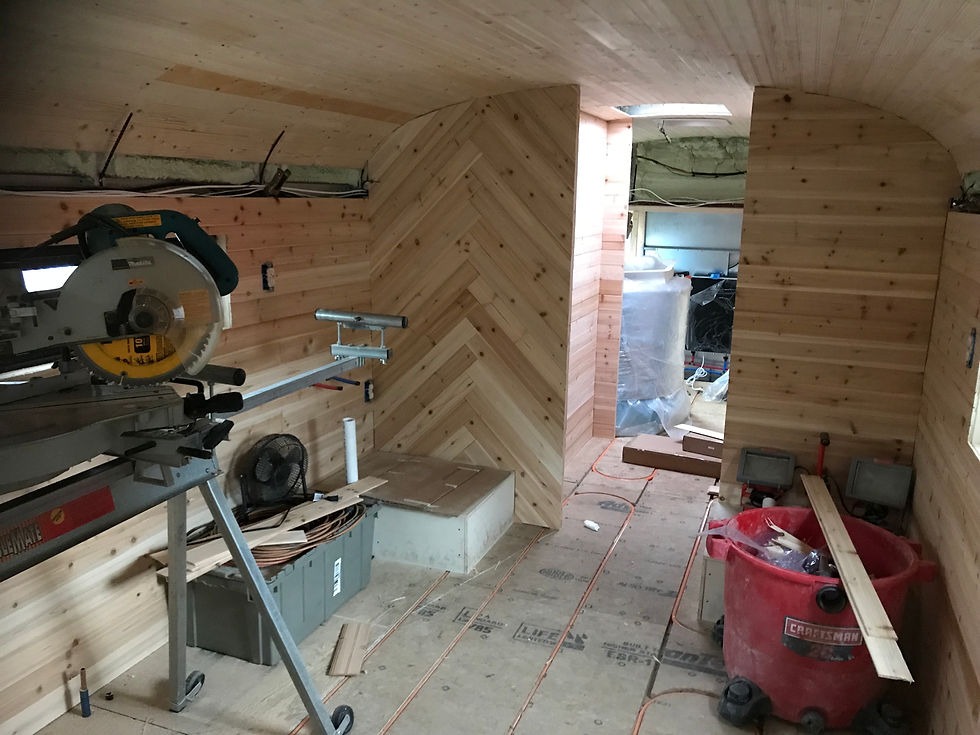


As it turned out, our Skoolie's kitchen had more working surfaces than our house.
One helpful addition was a pull-out counter for that extra four square feet of space:

Instead of an RV fridge or a full-sized fridge, we ended up using chest freezers on sliding pull-out tracks.
We used one large one as a freezer (where we could stockpile soups, meats, and prepped meals for going off-grid), the smaller chest as a fridge.


Given that their lot in life is to freeze anything and everything, we used a brewer's thermostat to control the temperature of the refrigerator side.
The thermostat reads the temperature inside from a wired probe. and cuts the power to the appliance once it gets down to refrigerator temp (38°F), preventing it from reaching freezing temps.
The Wood Stove
This is one place where we learned a real lesson about #buslife. We wanted a wood stove as a means of heating the bus, and as a feature of ambiance.
I remember a very cold night (about 19°F outside) spent feeding the tiny wood stove to keep the bus just above freezing. Not long after I installed two diesel parking heaters to get the job done more effectively.


But, given the choice to do it all over again, I would still install a wood stove. It's so cheerful and cozy!
Laundry and Library
Separating the forward compartment from the rear is the all-important door:


From the top of the door in the back we hung our laundry bag.
Speaking of laundry:

We literally wore that thing out as we were doing two or three loads of kids clothes plus cloth diapers every day.
We didn't always use the built-in dryer; only when it was too humid for things to dry. Meanwhile in the desert:

The laundry area was also a library and a play space:


Note additional closet / storage space just behind the play house, next to the silks.
Kids Bunks
In many school bus layouts that I have seen, the kids bunks are often used as a hallway, with bunks on each side there the user climbs in or out from the wide part of the bunk.
Our bunks share the aft area of the bus with the bathroom. So, the entry to the bunks is on the short side. We had the mattresses custom made of wool and organic cotton.


The Bathroom - a tale of two Skoolie Toilets
We wanted to avoid using a black water tank and plumbing in an RV or marine flush toilet. At first, we thought we would use an incinerator toilet.
Looking back, that idea was beyond laughable - glad we didn't.
Version one was a cartridge toilet, meaning it has its own little black water tank and when full, the cartridge is carried outside and emptied manually into a dump station.
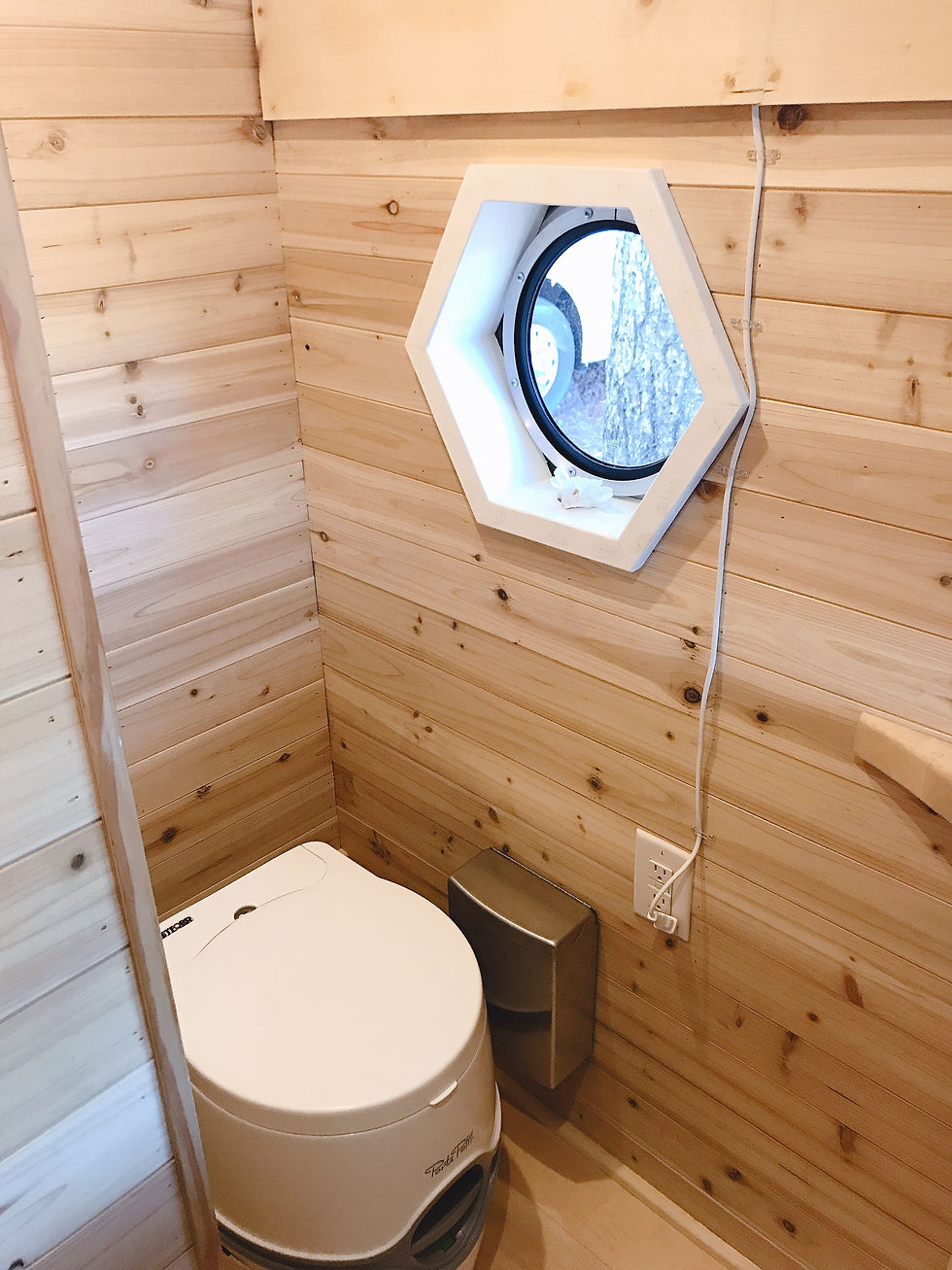
For version two we took a far simpler approach - a dry toilet system.


First, liquids and solids are separated using a urine diverter, which is plumbed into the gray water tank.
ahem... Dad jokes.
Moving on:

Solids are covered with a cover material like peat, small animal bedding (that recycled newspaper pulp), or sawdust.
The cover material (when used correctly) completely eliminates odor.
For insurance, we added a fresh air intake fan and an exhaust fan inside of the inner compartment, just in case anyone used too little cover material (or forgot entirely).

We chose to use cedar shavings as they have a very pleasant smell and are easy to find at a pet store or feed/tack/farm store.
Is that a Composting Toilet in your Skoolie?
Yes and no. I would call it a dry toilet or a cover toilet.
Some very fancy and complicated composting toilets made for Skoolies, boats, and RVs do a sort of "pre-composting" cycle where solid contents are stirred and dehydrated.
This is almost as complicated a process as the incinerator toilet - which we (thankfully) decided not to install.
Having used one of the most popular composting toilets in the past, we can say that they aren't foolproof - and when used improperly they give off a most foul odor.
The dry toilet system is much more forgiving because it's much simpler - no stirring, no dehydrating - just layering.
The question is: what do you do with the contents of your composting toilet, versus the contents of your dry toilet, once full?
While on the move, either system's output gets tied up in a compostable bag and put into a dumpster - no different than throwing away used baby diapers, only there's far less plastic involved.
If the bus is stationary and it's available, the contents of either system can be composted using the most low-tech sanitation technology known to nature: thermophilic composting.
Yep, your ordinary compost pile can safely kill pathogens and convert your poop into healthy and rich soil. No purchase necessary.
Note that a fancy toilet system that touts itself as a "composting toilet" isn't really composting, technically speaking. It's just preparing the media to be composted.
It's kinda like those countertop food scrap "composters", which just grind up your banana peels and dehydrate them. The peels aren't actually composted until nature's composting squad (invertebrates, bacteria, and fungi) have their go - once in contact with soil.
The Bathroom - Our mobile Hot Spring
Ok, this was our ridiculous splurge moment. We wanted a bathtub for the kids (and ahem for the adults). But, we didn't have the space for a rectangular one (like a claw foot tub - which would also have been a dream).
We landed on a deep, tall, circular stainless steel tub:
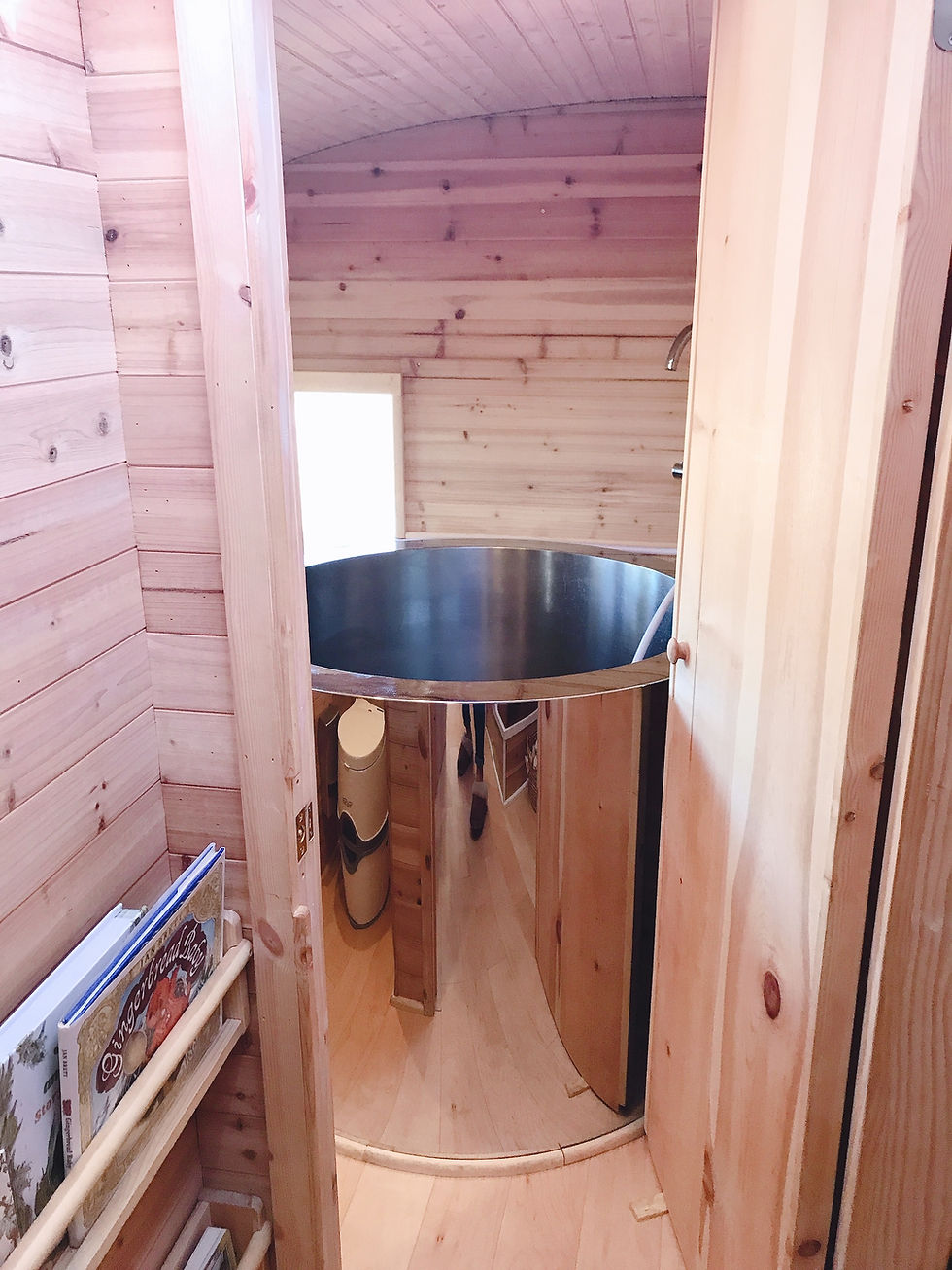

The idea was that when a quick shower is warranted, there is a built-in step to sit on and the handheld shower works like the seated showers you would find in Japan or Korea.
The tall sides keep the splashing water (ahem and kids) from spilling out.
And whenever when you can find an extra 50 gallons, you can sit in hot water deep enough to come up to your neck. Mmmm...
And we wanted to make sure that the tub had a view - for forest bathing:


The best thing about having the tub on board was bringing the bus to the beach. We would draw the bath as the kids started to tire of the salt and sand; they would hop right in and warm right up.
Then jammies, dinner, brushing teeth and hair, and a short drive back to the campground - which usually meant we rolled in with two sleeping kids and a free evening among adults.
And there you have it
From graphing paper and sticky notes to real life.
Carson, the butler of Downton Abbey, once said "The business of life is the acquisition of memories; in the end, that's all there is"

Appa is a Skoolie For Sale
If you're interested in starting your own #buslifeadventure let us know. We're happy to share our greatest triumphs and biggest beats of our lives as a full time family; no purchase necessary. And if you're looking to buy a bus, we can help with that too. Appa is up for sale on a sliding scale.


Comments